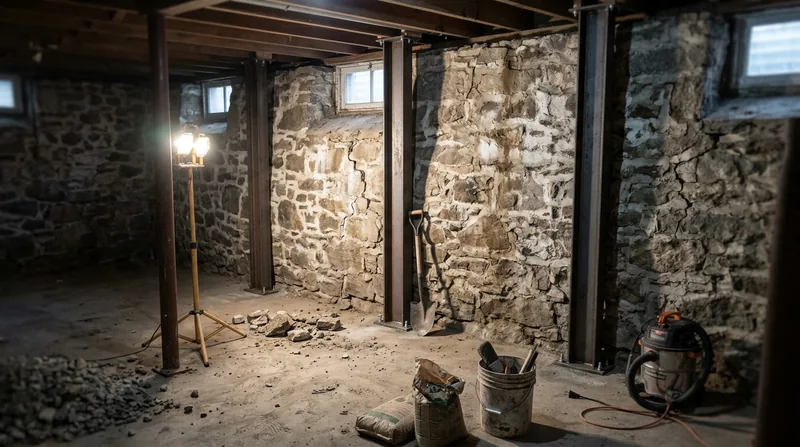




Bowing Wall Repair in Stamford: Stop the Push Before It Wins
Stamford sits on glacial till over gneiss and schist bedrock, and that shallow seasonal water table around the Cove and Shippan Point puts real hydrostatic pressure on basement walls every spring. In Glenbrook and Springdale, the 1900s to 1930s colonials and foursquares still carry original fieldstone and brick foundations that were never built for today's saturated soils. Up in Newfield and Turn of River, the 1940s to 1960s Capes and ranches often have partial basements with early poured walls that crack and lean as freeze-thaw winters work them year after year. If a wall in your basement is bowing inward, Bowing Wall Repair in Stamford is the work that stops the movement and stabilizes the wall before the floor joists above start to feel it. We match the repair to the severity of the bow and the soil pushing on it, and we tell you plainly when a wall is stable enough that crack sealing is all you need. Start with a free basement inspection so we can measure the movement instead of guessing at it.
Why Bowing Walls Are a Stamford Problem, Not a Cosmetic One
A bowing wall is a structural warning, not a cosmetic flaw. When saturated glacial clay soil and a rising water table press against an old fieldstone or brick wall, the wall moves inward at mid-height because the footing holds the bottom and the floor framing holds the top. In Stamford, nor'easters and spring rain push that pressure hard, and storm surge rides up the Sound on the coastal lots near Shippan Point and Harbor Point, where lower levels sit close to the tide. Freeze-thaw winters open the cracks wider each year. The failure mode that dominates here is horizontal cracking and inward lean on older walls driven by hydrostatic pressure, not settling from above.
- You see horizontal cracks running along the mortar joints at mid-wall, which is the classic sign of soil pressure rather than shrinkage.
- The top of the wall has moved inward while the base stays put, so the wall leans into the basement.
- Doors and windows on the main floor above stick or rack out of square as the wall pushes the framing.
- White efflorescence and damp patches show water is already moving through the wall, not just staining it.
- The basement floor near the wall heaves or cracks as the footing shifts under the load.
Any one of those signs is worth a measurement, and two or more together mean the wall needs stabilization, not another coat of paint.
Key info: A fieldstone wall in Glenbrook that has bowed a half inch over ten years is a different job from a poured wall in Turn of River that moved an inch in one wet spring. We measure the bow, check the soil and drainage behind it, and tell you which repair actually fits. The City of Stamford Building Department handles structural repair permits, and rules vary, so verify the current requirements before work starts: City of Stamford official site.
How We Stabilize a Bowing Wall in Stamford
We do not guess at a repair from the basement floor alone. The first step is reading the whole wall: the amount of bow, the wall material, the soil behind it, and how the water is moving. That tells us whether the wall needs carbon fiber straps, steel I-beams, or wall anchors, and whether the pressure behind it has to be relieved first. If hydrostatic pressure is the driver, stabilizing the wall without addressing the water is a temporary fix, and we say so. For walls that also take water, we pair the structural work with an interior drain tile system so the soil pressure and the seepage are handled together.
- We inspect and measure the wall, map the cracks, and check the drainage and grading outside.
- We identify what is pushing the wall: saturated till, a blocked footing drain, or a downspout dumping water at the foundation.
- We recommend the repair method that matches the severity: straps for a mild bow, I-beams for a heavier one, anchors where the soil load is high.
- We relieve the water pressure with drainage work where needed, so the repair is not fighting the same load next spring.
- We install the stabilization system, torque it to spec, and document the wall position so future movement can be checked.
- We walk you through what to watch and when to call us back.
The goal is a wall that stops moving and a basement that stays dry through the next nor'easter, not a patch that hides the problem until the next wet season.
Key info: On a 1920s foursquare near the Downtown core, we found a fieldstone wall bowed about an inch at mid-height with a blocked footing drain behind it. We installed carbon fiber straps across the bow and cleared the drainage, and the wall has held its position through two spring thaws. In Darien and Norwalk, the same pattern shows up on older poured walls where downspouts discharge right at the foundation.
Repair Methods We Match to Your Wall and Soil
No single method fits every bowing wall. The right choice depends on how far the wall has moved, what it is made of, and how much soil load it carries. Here is how we match the approach to the condition we find.
| Approach | Description | Best for |
|---|---|---|
| Carbon fiber straps | Straps bonded vertically to the inside face of the wall, anchored top and bottom, to arrest a mild to moderate bow. | Poured and block walls with a bow under about two inches and no active cracking through the wall. |
| Steel I-beams | Vertical steel beams set against the wall and tied into the floor and framing to resist heavier soil load. | Walls with a larger bow or where the soil pressure is high and the wall needs a stiffer brace. |
| Wall anchors | Anchors set in the soil outside and connected through the wall to plates inside, to pull the wall back and hold it. | Walls where the bow can be corrected and the outside soil is accessible for anchor installation. |
| Drainage relief | Interior perimeter drain and sump work to lower the water table and cut the hydrostatic pressure behind the wall. | Walls that also seep or show efflorescence, where water pressure is driving the movement. |
We often combine two of these, because a stabilized wall still needs the water load removed if the basement is going to stay dry.
Bowing Wall Repair Cost in Stamford: What to Expect
Homeowners ask us for a number before they ask anything else, and that is fair. Bowing wall repair starts from $600 for the smallest stabilization scope, and the price climbs with the length of wall, the repair method, and how much drainage work is needed to relieve the pressure. A short run of carbon fiber straps on a mild bow is a very different job from steel I-beams across a full wall with an interior drain tile system behind it. We give you a written scope and price after the inspection, not a phone estimate that changes on site. You can see the full range of our work on the pricing page.
- The linear footage of wall that has moved is the biggest cost driver, since straps and beams are priced by the run.
- The wall material matters, because fieldstone and brick take more prep than a clean poured wall.
- The repair method follows the severity, so a heavier bow needs beams or anchors rather than straps.
- Drainage work to relieve hydrostatic pressure adds scope, but skipping it can mean the wall moves again.
- Access to the wall inside the basement affects labor, especially in finished or tight spaces.
Get two or three estimates and compare the scope, not just the bottom line, because a low number that skips the drainage is not the same repair.
Bowing Wall Repair Near Me: How to Choose a Contractor in Stamford
When you search for bowing wall repair near me in Stamford, the results all sound similar. The difference shows up in the details, so ask the questions that separate a specialist from a generalist. We inspect before we quote, and we tell you when a simple crack repair is enough and when the wall needs stabilization.
- Confirm the contractor is licensed and insured for structural foundation work in Connecticut, and ask for the certificate.
- Get two or three written estimates that describe the method, the scope, and the drainage plan, not just a price.
- Ask for references from Stamford jobs with the same wall type and bow as yours.
- Check who pulls the permit, since structural foundation repair commonly requires one and rules vary by jurisdiction.
- Ask how they will relieve the water pressure, because a wall stabilized against a wet soil load will move again.
If a contractor cannot explain why your wall is bowing, they cannot fix it. Call us at (475) 268-0034 or contact us to set up an inspection and get a straight answer.
Bowing Wall Repair in Stamford: Pricing Guide
| Service | Price | Details |
|---|---|---|
| Carbon fiber strap stabilization | Starting at $600 | Covers a short run of straps on a mild bow, with wall prep and anchoring included. |
| Steel I-beam installation | Starting at $1,800 | Heavier stabilization for a larger bow, priced by wall length and beam spacing. |
| Wall anchor system | On estimate | Requires outside soil access and a site-specific layout, so we price it after inspection. |
| Drainage relief add-on | On estimate | Interior perimeter drain and sump work to cut hydrostatic pressure behind the wall. |
| Travel | Included | In Stamford and surrounding areas, with no separate call-out or mileage fee. |
| Estimate | Free | Response within 24h at (475) 268-0034, with no obligation to book. |
Indicative pricing, the exact cost depends on square footage, finish, and site access. Free personalized estimate within 24h at (475) 268-0034.


