



Basement Waterproofing in Stamford: Built for Glacial Till, Nor'easters, and Old Fieldstone
If you are looking for Basement Waterproofing in Stamford, the first thing to understand is that this city does not have one water problem, it has four. In Glenbrook and Springdale, 1900s-1930s colonials and foursquares sit on full basements with fieldstone, brick, or early poured walls that have been taking groundwater for a century. In Newfield and Turn of River, 1940s-1960s Cape Cods and ranches often have partial basements that seep at the cove joint. Up on the hills, 1970s-2000s colonials and split-levels have poured walkout basements where hydrostatic pressure finds the cold joint. And near Shippan Point, the Cove, and Harbor Point, lower levels sit close to the tide, so storm surge and a shallow seasonal water table push water in from below, not just from the sides.
The ground here is glacial till over gneiss and schist bedrock, which means water moves sideways along the rock and sits in the low ground. Freeze-thaw winters work every crack open a little wider each year. We trace the actual water path before we quote anything, because sealing a wall that is being pushed from underneath is wasted money. Start with a free basement inspection and we will tell you plainly what you are dealing with.
Why Wet Basements Are a Stamford Problem, Not a Maintenance Failure
Most Stamford homeowners did not neglect their basements. The building stock predates modern waterproofing, and the geology concentrates water. Fieldstone walls in Glenbrook were laid with mortar that has softened over 90 years, so seepage comes through the joints, not just the cracks. Early poured walls near the Downtown core often have no footing drain at all, or a weeping tile that has silted shut. On the hills, the problem is volume: a nor'easter drops two inches and the glacial till cannot absorb it fast enough, so it loads the wall.
Here is what we find most often when we open up a Stamford basement:
- Efflorescence on the lower block courses tells you water is moving through the masonry and evaporating inside.
- Water after rain along the wall-floor joint points to hydrostatic pressure at the footing, not a wall crack.
- Musty basement smell usually means moisture is trapped behind a wall finish or under a failing vapor barrier.
- Sump pump failure shows up as a wet floor after the first big spring storm, often on a pump that ran fine all winter.
- Rusty nail heads and stained boxes near the floor line confirm recurring seepage even when the floor looks dry on inspection day.
The right fix depends on which of these you have, and a system sized for the wrong failure mode will not hold.
Key info: On the low ground around the Cove and Shippan, we routinely find the water table sitting within a foot of the footing during spring. In those homes, an interior perimeter drain and a properly sized sump basin do more than any exterior coating, because the water is coming up, not just in.
For the official word on what requires a permit in Stamford, check the city's building department before any structural or drainage work begins: City of Stamford Building Department.
How We Waterproof a Stamford Basement: Diagnose First, Then Build the System
We do not sell one method to every house. The first visit is a diagnostic walk of the basement and the grade outside. We look at wall type, crack pattern, floor level versus the storm drain, downspout discharge, and where the ground slopes toward the foundation. Then we recommend the smallest system that actually solves the problem. If a single settling crack is the only entry point, we say so and inject it. If the whole wall is damp after rain, that is a different conversation.
- We map the water path: wall seepage, cove joint, floor crack, or rising water table.
- We check the existing drain tile and sump basin, and test the pump if one is present.
- We correct grading and downspout extensions on the outside where that alone will relieve the load.
- We install the interior perimeter drain and sump basin where hydrostatic pressure is the driver.
- We seal wall penetrations and apply the appropriate wall treatment or vapor barrier.
- We test the system with water before we close up and hand over the basement dry.
Every step is documented, and we walk you through what we found in plain language, not a sales script.
Key info: A Newfield ranch we inspected last spring had water pooling at the base of the chimney wall after every storm. The cause was a clogged footing drain and a downspout dumping at the corner. We cleared the drain, extended the downspout, and sealed the wall joint. No excavation, no full system. That is the honest answer when it is the right one.
If your basement has a finished side or a walkout, the same diagnosis applies, but the drainage detail changes. See how we handle interior drain tile systems for the full method.
Waterproofing Methods We Use in Stamford Homes
Each approach solves a specific failure mode. We match the method to the water path, not the other way around.
| Approach | Description | Best for |
|---|---|---|
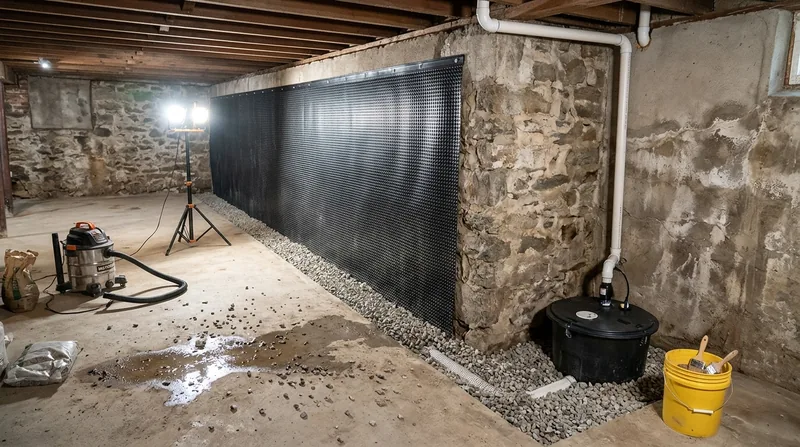
| Interior perimeter drain | A dimple board and drain tile system installed at the footing inside the basement, feeding a sump basin. | Hydrostatic pressure and rising water table, common near the Cove and Shippan. |
| Exterior waterproofing | Excavation to the footing, membrane and dimple board on the wall, new footing drain and gravel. | Walls that are damp through the masonry and where the grade allows excavation. |
| Crack injection | Epoxy or polyurethane injection through ports into a settling or leaking crack. | Isolated poured-wall cracks that leak after rain but show no bowing. |
| Wall sealing and vapor barrier | Surface sealing of block or poured walls plus a vapor barrier to control moisture migration. | Damp walls with efflorescence and a musty smell, no standing water. |
| Sump pump and backup | A correctly sized sump basin, primary pump, check valve, and battery backup on the discharge line. | Any basement with a drain system, especially where power loss during a nor'easter is likely. |
We will tell you when a simpler repair is enough, and when the real problem is pressure that only a drain system will relieve.
Basement Waterproofing Cost in Stamford: What to Expect
Most Stamford homeowners want a number before they want a method, and that is fair. As a starting point, interior systems begin around $2,500, and the final figure depends on linear footage, wall type, whether a sump basin and pump are already in place, and access. A Glenbrook fieldstone basement with a finished ceiling and tight stair access takes more labor than an open poured basement on a Weston hillside lot. Coastal homes near Harbor Point may need a larger basin and a backup pump because the water table stays high longer.
Factors that move the price most: the length of wall to be drained, whether we are cutting a new sump basin or reusing an existing one, the condition of the existing drain tile, and whether grading and downspout work are part of the scope. Getting two or three estimates is smart, and we encourage it. Ask each contractor what failure mode they identified and what their system does about it. For a fuller breakdown, see our basement waterproofing pricing page.
Finding a Basement Waterproofing Contractor Near Me in Stamford
Waterproofing is a below-grade trade, and the license and insurance matter more than the truck wrap. Ask for the certificate of insurance and confirm the license before work starts. Ask for references from jobs in your neighborhood, not a generic list. Ask who pulls the permit if the work touches structural repair or the sump discharge connection. In Stamford, the building department sets those thresholds, and they vary by jurisdiction, so verify rather than assume.
A few practical checks when you are comparing contractors near Stamford:
- Confirm the company is licensed and insured, and ask for the certificate before signing.
- Get two or three written estimates that name the method and the failure mode.
- Ask for references from basements similar to yours, fieldstone or poured, full or partial.
- Ask whether a permit is required for your scope and who is responsible for pulling it.
- Get the warranty terms in writing, including whether it is transferable.
If a contractor cannot explain why your basement leaks, they cannot fix it. Reach out through our contact page and we will schedule a free inspection.
For homes in the 06905 ZIP code, see our local page: basement waterproofing in Stamford 06905.
Basement Waterproofing in Stamford: Pricing Guide
| Service | Price | Details |
|---|---|---|
| Crack injection (epoxy or polyurethane) | Starting at $2,500 | Includes injection ports and sealing of an isolated poured-wall crack, with access and crack length moving the price. |
| Interior perimeter drain and sump basin | Starting at $4,500 | Covers drain tile, dimple board, and a new sump basin, with linear footage and wall type driving the cost. |
| Exterior waterproofing with footing drain | On estimate | Requires excavation to the footing, membrane, and new drain; site access and depth determine the scope. |
| Sump pump replacement with battery backup | Starting at $1,200 | Includes pump, check valve, discharge line, and backup unit, with basin condition and discharge routing affecting labor. |
| Travel | Included | In Stamford and surrounding areas, no separate call-out or mileage fee. |
| Estimate | Free | Response within 24h at (475) 268-0034, no obligation to book. |
Indicative pricing, the exact cost depends on square footage, finish, and site access. Free personalized estimate within 24h at (475) 268-0034.


