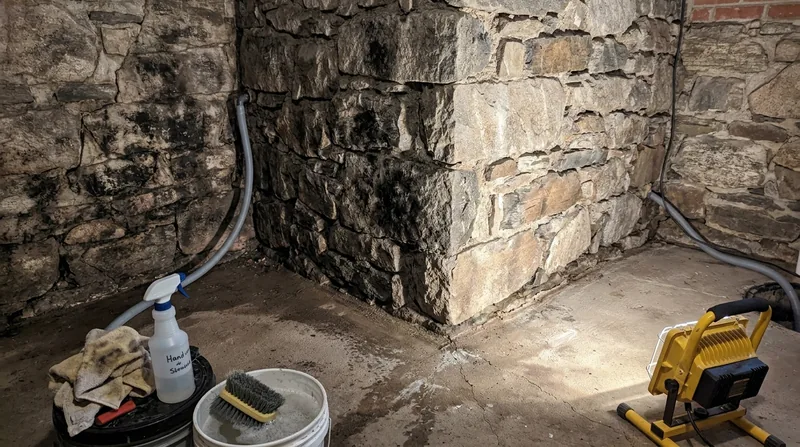




Stamford sits on glacial till over gneiss and schist, and that geology decides where basements stay dry and where they don't. In Glenbrook and Springdale, 1900s colonials and foursquares sit on full basements with fieldstone or early poured walls that wick groundwater straight through the mortar. Down around the Cove and Shippan Point, the seasonal water table runs shallow and storm surge rides up the Sound, so lower levels take on water fast. Basement Mold Remediation in Stamford starts with finding the moisture source, not scrubbing the drywall. We treat the affected surfaces, contain the work area, and fix the drainage or humidity problem that let mold grow in the first place. If you have a musty smell and no visible water, call our free basement inspection before the problem spreads.
Why Basement Mold Keeps Coming Back in Stamford's Older Housing Stock
Mold needs moisture, and Stamford basements have no shortage of it. Fieldstone walls in the older neighborhoods leak through mortar joints, early poured walls in Newfield and Turn of River crack along cold joints, and 1970s split-levels on the hills collect water where the footing drain clogs. Nor'easters and spring rain push the water table up, and the freeze-thaw cycle opens the same cracks wider every winter. Treating mold without fixing the water source just buys you a few months.
- Efflorescence on the wall tells you water is moving through the masonry, not just condensing on it.
- A musty smell that gets stronger after rain points to seepage at the wall-floor joint.
- Peeling paint and soft drywall at the bottom of the wall usually mean repeated wetting.
- Rust on the sump pump or a check valve that stays wet signals a pump that runs often or has failed.
If you see any of these, the mold is the symptom and the drainage is the cause. We test the moisture before we quote any remediation.
Key info: A 1920s foursquare off Glenbrook Road had mold on the lower two feet of a fieldstone wall. The owner had bleached it twice. Moisture readings showed the wall was wet from hydrostatic pressure, not condensation, so we fixed the drainage first and treated the wall second.
For the official word on mold and moisture in Connecticut homes, the state Department of Public Health publishes guidance at portal.ct.gov/DPH.
How We Run a Basement Mold Job in Stamford, Step by Step
We do not fog a basement and hand you a bill. The job starts with finding where the water comes from, because remediation without moisture control is a repeat visit waiting to happen. Here is the sequence we follow on a typical Stamford basement.
- We walk the basement and read moisture at the walls, the floor joint, and the rim area to map where water is entering.
- We set up containment with plastic and negative air so spores do not spread to the rest of the house during removal.
- We remove and bag porous materials that cannot be saved, such as wet drywall, insulation, and cardboard.
- We treat affected framing and masonry with an antimicrobial and HEPA-vacuum the whole area.
- We fix the moisture source: crack injection, interior perimeter drain, sump pump replacement, or a dehumidifier sized to the space.
- We verify with moisture readings and a visual check before we take down containment.
Most jobs finish in one to three days once the drainage repair is scheduled. If the source is a failed sump pump, see sump pump installation and replacement for how we size and set the new unit.
Key info: A ranch in Turn of River had a partial basement with mold across the ceiling joists. The cause was a discharge line that dumped water two feet from the foundation and ran back in. We extended the line, corrected the grading, and the joists dried to normal readings in four days.
Remediation Approaches We Use and When Each One Fits
Not every mold job looks the same, and the right method depends on how much material is affected and where the water came from. This table shows the approaches we use most in Stamford basements and the conditions each one suits.
| Approach | Description | Best for |
|---|---|---|
| Surface treatment and HEPA cleaning | Antimicrobial application and HEPA vacuuming of framing and masonry. | Light growth on joists, walls, and stored items. |
| Containment and material removal | Negative air, plastic barriers, and disposal of unsalvageable porous materials. | Wet drywall, insulation, and heavy growth after a flood. |
| Moisture source repair | Crack injection, drain tile, sump work, or grading correction paired with remediation. | Any basement where water is still entering. |
| Dehumidification and ventilation | Sized dehumidifier and air movement to hold basement humidity down. | Tight basements with condensation and musty odor. |
| Vapor barrier and wall sealing | Dimple board or vapor barrier against the wall to stop moisture vapor. | Damp masonry walls with recurring surface growth. |
We pick the approach after the moisture reading, not before. That is how you avoid paying for removal twice.
Basement Mold Remediation Cost in Stamford: What to Expect
Remediation in Stamford starts around $1,500 for a contained area with light growth and a straightforward moisture fix. From there, the number moves with square footage affected, how much material has to come out, and whether drainage work is part of the job. A single wall with surface growth on a fieldstone foundation is a different scope than a finished basement that took on two inches of water.
Getting two or three estimates is worth the phone calls. Ask each contractor what moisture source they found and how they plan to fix it, because a quote that only covers cleaning will not hold. Our full breakdown of rates is on the pricing page.
Basement Mold Remediation Near Me: How to Vet a Contractor Near Stamford
Anyone can buy a sprayer and a respirator. What separates a real remediation contractor is licensing, insurance, and a clear explanation of how they will stop the water. Ask for the certificate of insurance before work starts, and confirm the company carries general liability and workers' compensation.
- Get at least three written estimates and compare the scope line by line, not just the total.
- Ask for two recent references in Stamford or a neighboring town and call them.
- Confirm whether a permit is needed for any structural or drainage work, and check with the Stamford building department.
- Ask how they verify the job is dry at the end, and get that in writing.
If a contractor cannot tell you where the water is coming from, keep looking. Reach us through the contact page to schedule a free inspection.
Basement Mold Remediation in Stamford: Pricing Guide
| Service | Price | Details |
|---|---|---|
| Contained surface remediation | Starting at $1,500 | Covers containment, antimicrobial treatment, and HEPA cleaning for a limited area with light growth. |
| Remediation with material removal | Starting at $2,800 | Includes removal and disposal of wet drywall or insulation, plus containment and full area cleaning. |
| Remediation with drainage repair | On estimate | Priced after inspection because crack injection, drain tile, or sump work changes the scope. |
| Musty odor diagnostics | Included | Moisture mapping and source identification are part of every free basement inspection. |
| Travel | Included | In Stamford and surrounding towns, with no separate call-out or mileage fee. |
| Estimate | Free | Response within 24 hours at (475) 268-0034, with no obligation to book. |
Indicative pricing, the exact cost depends on square footage, finish, and site access. Free personalized estimate within 24h at (475) 268-0034.


