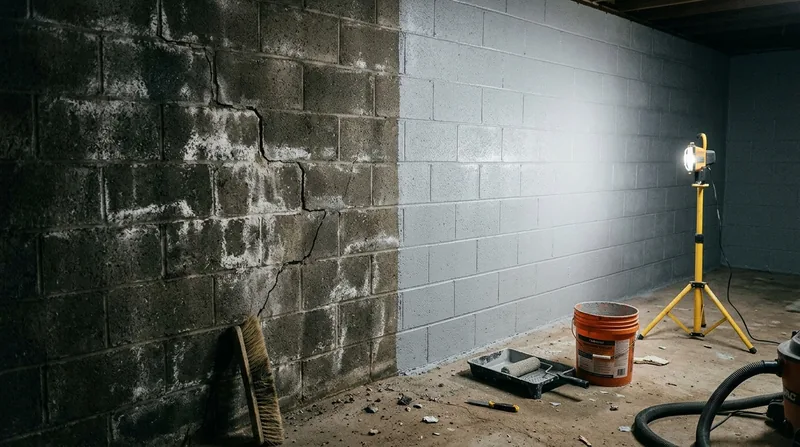




Stamford sits on glacial till over gneiss and schist, and that shallow seasonal water table in the low ground around the Cove and Shippan pushes moisture straight into basement walls all year. If you own a 1900s colonial in Glenbrook or Springdale with fieldstone or early poured walls, you already know the signs: white efflorescence blooming on the block, a chalky film that wipes off and comes back, and that damp smell after a nor'easter. Basement Wall Sealing in Stamford starts with an honest read of what is actually happening at the wall, because a sealer fixes surface dampness and nothing more. We prep the wall, strip the efflorescence, and apply the right penetrating or membrane product for your wall type. We also tell you plainly when the water is coming from hydrostatic pressure and sealing alone will not hold it. Call (475) 268-0034 to set up a free basement inspection, or read our full basement waterproofing service if you are still sorting out the source.
Why Basement Wall Sealing Matters in Stamford's Older and Coastal Basements
Stamford's housing stock is the reason this work comes up so often. The 1900s to 1930s colonials and foursquares near Downtown and in Springdale were built with fieldstone and brick walls that were never damp-proofed, and the 1940s to 1960s Capes in Newfield and Turn of River often have partial basements poured thin. Add freeze-thaw winters that open cracks every year and storm surge that rides up the Sound toward Shippan Point and the Cove, and wall seepage becomes a seasonal certainty rather than a surprise.
- Fieldstone and brick walls in Glenbrook wick groundwater and leave efflorescence on the mortar joints.
- Poured walls in the 1970s to 2000s hillside colonials develop hairline cracks that leak after every spring rain.
- Waterfront lower levels near Harbor Point sit close to the tide, so the water table rises against the wall from below.
- Homes in New Canaan and Darien on similar glacial till show the same damp pattern on north-facing walls.
Sealing buys you a drier wall surface and a cleaner basement, but only when the moisture is surface dampness and not a pressurized water problem.
Key info: A Springdale fieldstone wall that weeps after three days of rain is usually a hydrostatic pressure problem, not a sealer problem. On a wall like that, an interior perimeter drain and sump basin move the water before it reaches the floor, while sealing alone would just trap moisture behind a film.
For permit questions on any work that alters drainage or structural repair, verify the current rules with the City of Stamford building department before work starts, since thresholds vary by jurisdiction.
How We Seal a Basement Wall in Stamford, Step by Step
We start by reading the wall, not by opening a bucket. The prep work decides whether the sealer bonds or peels, and on Stamford's older masonry that means grinding out loose mortar, wire-brushing the fieldstone, and killing the efflorescence with a proper wash before anything goes on. We check for active cracks, bowing, and any sign that water is pushing in under pressure, and we tell you when sealing is the wrong tool for the job.
- We inspect the wall and floor joint for active seepage, efflorescence, and any crack wider than a hairline.
- We remove loose mortar, old paint, and mineral bloom so the surface is sound and dry enough to take the product.
- We treat active cracks separately, using epoxy or polyurethane injection rather than burying them under sealer.
- We apply a penetrating sealer on porous masonry or a membrane coating on poured walls, depending on what the wall needs.
- We check the exterior grade and downspout extensions so roof water is not dumping back against the same wall.
Every job ends with a walkthrough of what we sealed, what we left alone, and what to watch for at the next heavy rain.
Key info: On a 1950s ranch in Turn of River, we found the wall was damp but not leaking. Sealing plus a downspout extension solved it for a fraction of what an exterior dig would have cost. On a Cove-side basement with water rising at the floor joint, we recommended an interior drain tile system instead, because no sealer holds back the tide.
Sealing Approaches We Use on Stamford Basement Walls
Not every wall takes the same product. Fieldstone and brick behave differently from poured concrete, and a wall with active seepage needs a different answer than one that is simply damp to the touch. This table shows how we match the approach to the wall and the problem.
| Approach | Description | Best for |
|---|---|---|
| Penetrating sealer | Soaks into porous masonry and blocks capillary moisture without a surface film. | Damp fieldstone and brick walls with no active seepage. |
| Membrane coating | Flexible rolled or troweled coating that bridges hairline cracks on poured walls. | 1970s to 2000s poured basements on the Stamford hills. |
| Crack injection plus sealer | Epoxy or polyurethane injection fills the crack, then sealer treats the surrounding wall. | Walls with one or two defined leaking cracks after rain. |
| Sealer plus drainage correction | Sealing paired with grading fixes and downspout extensions to cut the water source. | Walls that stay damp because roof water runs back to the foundation. |
| Sealer with interior drain | Sealing as a finish coat over a wall protected by an interior perimeter drain and sump. | Cove and Shippan basements under real hydrostatic pressure. |
We recommend the lightest approach that actually solves your problem, and we say so when a sealer is not enough.
Basement Wall Sealing Cost in Stamford: What to Expect
Most basement wall sealing jobs in Stamford start from $1,500, and that figure covers a straightforward wall: prep, efflorescence removal, and a quality sealer on a basement of typical size. The number moves up with wall length and height, the condition of the masonry, how much efflorescence and old paint has to come off, and whether active cracks need injection before sealing. A fieldstone wall in Glenbrook takes more labor than a clean poured wall in a 1990s colonial, and that shows up in the price.
We quote after we see the wall, not over the phone, because a wall that looks damp from across the basement can be either a sealer job or a drainage job. Getting two or three estimates is smart, and so is asking each contractor whether they are sealing over a pressure problem. Our full pricing overview lays out the ranges for prep levels and wall types.
What to Look for When Hiring a Basement Wall Sealing Contractor Near Stamford
Basement wall sealing is easy to sell and easy to do badly, so the vetting matters. Ask for proof of licensing and insurance before anyone touches your wall, and get a certificate of insurance sent to you directly rather than a verbal yes. Get two or three written estimates that spell out prep steps, product type, and what happens if the wall turns out to need more than sealing. Check references from Stamford jobs on similar wall types, since a crew that only works on new poured concrete may not read a 1920s fieldstone wall correctly.
Ask whether the work touches drainage or structure, because that is where permits can come in, and confirm the local building department's current requirements. If you are in a condominium near Harbor Point, check the association's rules on exterior access and work hours before scheduling. Reach out through our contact page and we will walk you through what the inspection covers.
Basement Wall Sealing in Stamford: Pricing Guide
| Service | Price | Details |
|---|---|---|
| Single wall or small basement sealing | Starting at $1,500 | Includes surface prep, efflorescence removal, and sealer on one typical wall section. |
| Full basement, poured walls | Starting at $2,400 | Full perimeter membrane coating; price rises with wall height and crack count. |
| Fieldstone or brick wall sealing | Starting at $3,200 | Extra mortar prep and penetrating sealer; older masonry takes more labor hours. |
| Sealing with crack injection | On estimate | Active cracks need epoxy or polyurethane injection priced per crack after inspection. |
| Travel | Included | In Stamford and surrounding towns, with no separate call-out or mileage fee. |
| Estimate | Free | Response within 24 hours at (475) 268-0034, no obligation to book. |
Indicative pricing, the exact cost depends on square footage, finish, and site access. Free personalized estimate within 24h at (475) 268-0034.


